
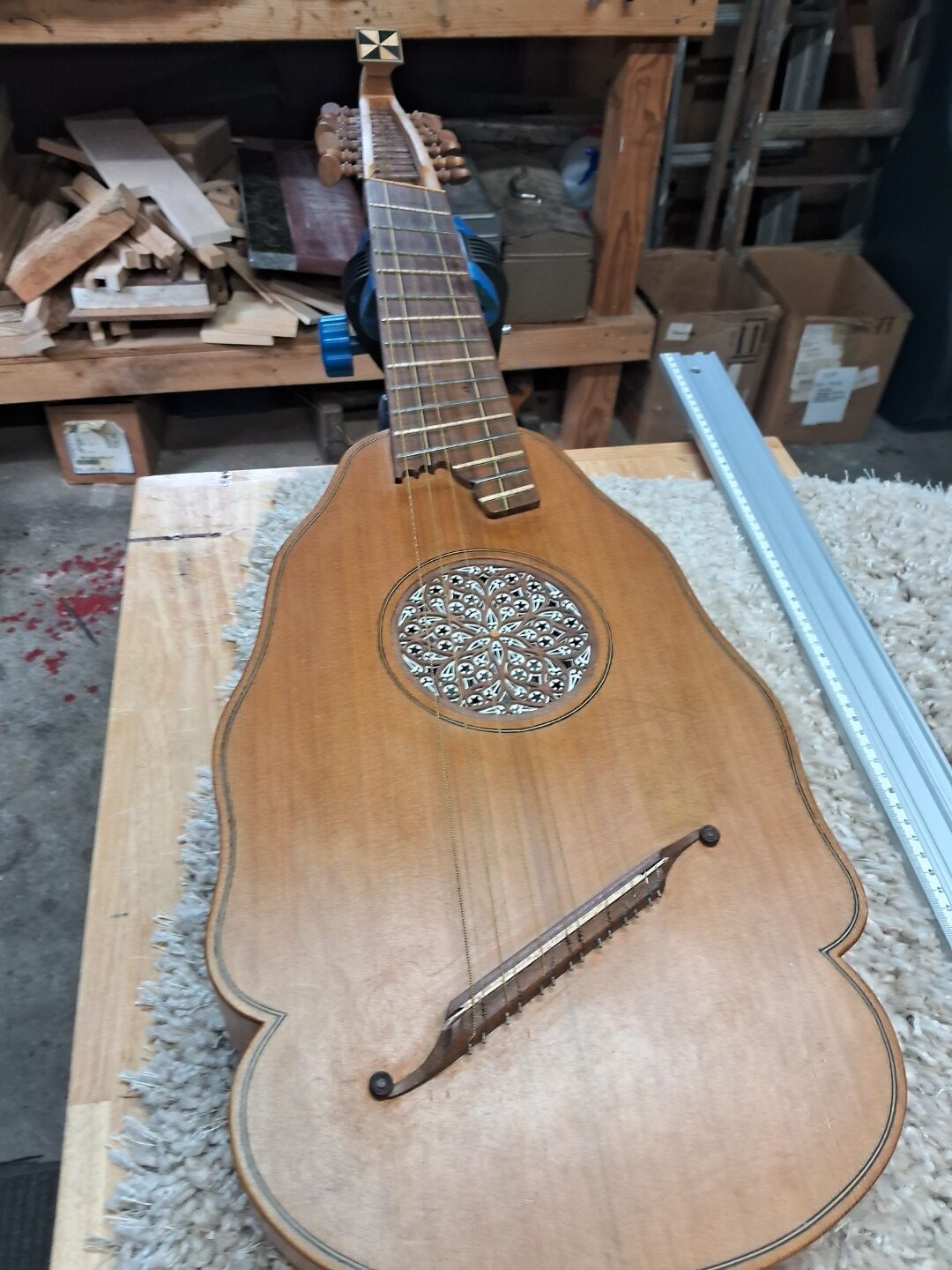
I sometimes receive unusual instruments needing repair, but recently I took on my first Renaissance instrument repair. A local musician brought me his Orpharion, in need of a neck reset, back repair, and bridge work.

The orpharion was developed in the 16th century for women whose voluminous dresses made it difficult for them to grasp a lute. Unlike the lute, it has hand-wound metal strings, giving it a shimmering sound unlike any instrument I’ve ever heard and a fan-shaped fretboard (like some heavy-metal guitars!) The strings were apparently also its demise as only one English string maker knew how to produce the very fine gauge (0.006”) treble strings, and when he died, no one took over his craft.

The orpharion I repaired is a reproduction of a 1617 instrument made by Francis Palmer. I opened up the back to adjust the neck angle and reinforce the wood strips which were coming apart. I also moved the bridge saddle back to improve its intonation (it was playing sharp). Finally, I strung it with new hand-wound brass and steel strings from a British supplier who makes period-appropriate strings.

Along the way, my customer provided me with a lesson on the historical development of fretted instruments in Europe, but that will be the subject of another post!